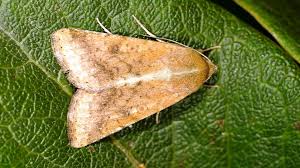


Adult Identification
- Wingspan: 32-40 mm (larger than most other bollworms)
- Forewings: pale yellow-brown to olive-green with a dark kidney-shaped spot and faint wavy cross-lines
- Hindwings: creamy white with a wide, dark grey-brown border along the outer edge
- Antennae: filiform (thread-like), not feathery
- Nocturnal: strong flier, migrates hundreds of kilometres in a season
- Does not rest in a tent-like posture; wings spread slightly flatter
Larval Identification
- Length at maturity: 35-40 mm (6 larval instars total)
- Body colour: highly variable; green, yellowish, brown, pinkish, or nearly black
- Pale and dark longitudinal stripes on the sides of the body
- Yellowish-brown head capsule with fine dark reticulate lines
- Often found half-inside fruit with head buried and abdomen visible
- When disturbed, curls into a C-shape; this is a key field ID sign
Taxonomy
| Kingdom | Animalia |
| Order | Lepidoptera |
| Family | Noctuidae |
| Genus | Helicoverpa |
| Species | H. armigera |
Global Distribution
- Present across all of Africa
- Asia: from Turkey to Japan and south to Australia
- Southern Europe: Mediterranean basin
- Invasive in Brazil and Argentina since 2013
- Altitude range in Kenya: 0-2,500 m
- Strongly migratory; populations move with rainfall fronts
In Kenya, the African Bollworm is a major threat to cotton, tomato, maize, sorghum, sunflower, chickpea, and many horticultural crops. It is especially dangerous because it develops resistance to insecticides rapidly, making chemical-only control programs increasingly unreliable. Annual global crop losses attributed to H. armigera are estimated at USD 2-5 billion, making it one of the costliest insect pests in agricultural history. Its strong night-flight ability and migratory behaviour mean new populations can appear in a field overnight, with no prior warning other than a pheromone trap.
H. armigera attacks over 180 plant species. It prefers crops with flowers, fruits, or seeds, where larvae can feed inside the structure and be protected from sprays. The most commercially important hosts in Kenya are listed below.
- Cotton (boll borer, severe)
- Tomato (fruit borer, major pest)
- Maize (earworm, tassel feeder)
- Sorghum (panicle feeder)
- Chickpea and pigeon pea (pod borer)
- Sunflower (seed head feeder)
- Tobacco (leaf and bud feeder)
- Cowpea and common bean (pod borer)
- Capsicum and sweet pepper
- Eggplant (aubergine)
- Okra
- Groundnuts (peanuts)
- Soybeans
- Lentils and lucerne (alfalfa)
- Wheat (head feeder)
- Strawberry
- Carnations and roses (cut flowers)
- Chrysanthemum
- Pelargonium (geranium)
- Wild Solanum spp. (weed hosts)
- Various Hibiscus species
- Flax and safflower
Helicoverpa armigera completes its life cycle in 28-42 days under warm Kenyan conditions, giving 4-6 overlapping generations per year. There is no true dormancy in the tropics: populations are continuous. In cooler highland conditions above 2,000 m, pupae may enter a short diapause (resting phase) during cold dry periods, slowing development. A single female lays up to 1,500 eggs in her lifetime, making population build-up very rapid when conditions are right.
| Temperature | Generation Time | Larval Duration | Egg Hatch | Notes |
|---|---|---|---|---|
| 15 °C | ~65 days | 30-35 days | 8-10 days | Slow development; highland cool season |
| 20 °C | ~45 days | 20-25 days | 5-7 days | Typical highland Kenya; moderate risk |
| 25 °C | ~32 days | 15-18 days | 3-5 days | Optimal; most Kenyan growing zones |
| 30 °C | ~25 days | 12-15 days | 3-4 days | Lowland and semi-arid areas; rapid build-up |
| 35 °C | ~20 days | 9-12 days | 2-3 days | Very fast; hot dry season populations spike quickly |
All damage is caused by larvae. Early instar larvae feed on the surface of leaves, flowers, and young fruits, creating small holes and ragged edges. From the 3rd instar onwards, they bore inside fruits, pods, and bolls, where they are completely protected from surface sprays. The larva often feeds with its head buried inside the fruit and its abdomen visible at the entry hole. This is the most commercially destructive feeding behaviour.


African Bollworm is a fast mover. Once larvae are inside fruit or bolls, surface sprays cannot reach them. Early detection focuses on catching adult moths with pheromone traps, scouting for eggs on young growth, and spotting surface-feeding first-instar larvae before they bore in. Acting at this early window saves the crop.
- Single white ribbed eggs on young leaves, flower buds, and growing points (check the top 20 cm of the plant daily)
- Tiny surface-feeding holes on petals and tender leaves (1st-2nd instar larvae)
- Circular entry holes on fruit or boll surface, surrounded by green moist frass
- Larva protruding half-body from tomato fruit, head buried inside
- Premature shedding of cotton squares (flower buds falling to the ground)
- Frass-filled silk on maize cobs; poor kernel set at the cob tip
- When disturbed, larvae curl tightly into a C-shape; a key identification sign
- Fruit or pods with internal cavity, hollowed seeds, and secondary rot smell
- Pupae found during soil tillage: smooth, shiny, brown, 5-10 cm deep
- Adult moths resting on undersides of leaves or soil surface during the day
Pheromone traps are your first line of warning. Helico-Enemy™ lures in Delta or Funnel traps attract male moths several days before eggs are laid in the field, giving you time to act.
- Deploy 10 traps per hectare minimum, hung at crop canopy height
- Check and count catches every 7 days; keep a written record
- Replace sticky inserts every 3-4 weeks or when more than 50% covered
- Replace lures every 6-8 weeks as per product label
- A rising catch trend over 2-3 consecutive weeks signals an active egg-laying wave
- In large fields: use 1 trap per 2-3 ha minimum; denser for more precise data
| Trap Catch (moths/trap/week) | Action Required |
|---|---|
| 0-3 | Low: continue monitoring; no immediate intervention needed |
| 4-8 | Moderate: intensify scouting for eggs and young larvae; prepare spray |
| 9-15 | High: apply bioinsecticide spray immediately; check all crops |
| 15+ | Critical: full spray program; increase trap density; apply Bt and NPV |
| Crop | Growth Stage | Damage Threshold | Trap Threshold (moths/trap/week) |
|---|---|---|---|
| Cotton | Vegetative (before flowering) | 2-3 larvae per 25 plants; treat before flowering begins | 8-10 moths triggers preparation |
| Cotton | Flowering to boll fill | 1 larva per 25 plants; zero tolerance during boll fill | 5 moths per trap per week; act immediately |
| Tomato | Fruiting | 1-2% damaged fruit on random sample of 50 fruits | 8 moths per trap per week |
| Maize | Silking to grain fill | 5% ears with damage triggers intervention at grain fill | 10 moths per trap per week at silking |
| Chickpea | Flowering and pod set | 1-2 larvae per metre row; spray at first egg hatch | 5 moths per trap per week during flowering |
| Sorghum | Heading to grain fill | 5-10% heads with live larvae | 10 moths per trap per week at heading |
- Collect and destroy all infested fruits, damaged cotton bolls, and shed squares at least twice per week during the growing season (do not compost; bury at 60 cm depth or burn off-site)
- After harvest, immediately destroy all crop residues by deep ploughing or burning to kill overwintering pupae in the soil
- Clear all flowering weeds around field margins before the next crop is planted, removing the reservoir population
- In tomato: strip off and destroy all infested fruits immediately; do not leave them to rot on the ground under the plant
- Deep plough or disc fields after harvest to expose pupae to sun, desiccation, and bird predation
- Use Helico-Enemy™ sex pheromone lures in Delta or Funnel traps to monitor adult male moth populations in real time
- Monitoring rate: 10 traps per hectare, hung at canopy height; count catches every 7 days and keep records
- Rising trap catches over 2-3 consecutive weeks indicate an active egg-laying event; spray within 48-72 hours of this signal
- Replace lures every 6-8 weeks; replace sticky inserts every 3-4 weeks or when 50% covered
- Traps provide advance warning 5-7 days before larvae appear in the crop, the critical window for effective bioinsecticide application
- NPV-Helicoverpa (Nucleopolyhedrovirus): The most specific and effective biological control for H. armigera. Spray at 1 kg/ha when eggs are hatching. Young larvae ingest the virus, sicken within 3-5 days, and die, releasing billions of new virus particles to infect other larvae. No resistance develops. Zero residues.
- Bacillus thuringiensis (Bt kurstaki or aizawai): Apply at 1 kg/ha when young larvae are present on the plant surface. Bt crystals are ingested by larvae, perforate the stomach lining, and kill them within 2-4 days. Apply in the late afternoon as UV degrades Bt rapidly. Highly safe for bees and beneficials.
- Beauveria bassiana and Metarhizium anisopliae: Spores attach to the larval cuticle, germinate, and kill the larva. Effective on surface-feeding larvae. Apply at 1 kg/ha or 1 L/ha in the late afternoon. Repeat every 7-10 days during peak pressure.
- Soil application of Metarhizium: Drench soil beneath crop with Metarhizium at 2-4 kg/ha to kill pupae in the soil and reduce the emerging adult population for the next generation.
- Trichogramma egg parasitoid wasps: Release at 3 cards per hectare per week when pheromone trap catches start rising. These tiny wasps lay their eggs inside Helicoverpa eggs on the plant, consuming them before they can hatch into larvae. Most effective in dense canopy crops (tomato, chickpea).
- Telenomous remus parasitoid: Specifically attacks Spodoptera egg masses and is complementary where both armyworm and bollworm are present. Releases at 2 cards per hectare.
- Native parasitoids: Several Braconid and Ichneumonid wasps (including Campoletis chlorideae) naturally parasitise Helicoverpa larvae in Kenya. Avoid broad-spectrum chemical insecticides that kill these beneficial insects.
- Birds and ground beetles: Maintain vegetation strips and mulch to support ground predator populations that prey on pupae and newly emerged moths.
- Plant early in the season to allow crop flowering to occur before peak bollworm migration; late-planted crops suffer far more damage
- Use short-duration varieties where possible to reduce the overlap between the most susceptible crop stage (flowering and fruiting) and peak moth populations
- Avoid monocropping large areas of tomato or cotton; intercrop with non-host crops like maize and beans to dilute pest pressure
- Introduce trap crops (e.g. African marigold, Tagetes erecta, or pigeon pea) at field borders to attract egg-laying females away from the main crop
- Ensure balanced crop nutrition: well-fed plants compensate better for bollworm damage; nitrogen excesses make crops more attractive to egg-laying females
- Apply foliar chitosan (SHELLIGHT-Chitosan) to toughen leaf and fruit surfaces, making young larval penetration harder, and to activate the plant's own immune system
- Avoid planting susceptible crops (tomato, cotton) next to an existing infested crop in the same season
These products from Bioenemy Africa are designed for African Bollworm management at different stages of the pest life cycle. They work best when combined into a complete, season-long IPM program rather than used as one-off rescue treatments.
Deploy Helico-Enemy lures in Delta traps for monitoring. Scale to Funnel traps for mass trapping. Record catches weekly to predict egg-laying events and time your sprays.
Apply NPV and Bt when eggs are hatching and larvae are on plant surfaces. Apply Metarhizium as a soil drench to kill pupae before they emerge as adults.
Release at 3 cards per hectare per week when trap catches are rising. Kills the bollworm inside the egg before it ever hatches into a destructive larva.
Apply as a foliar spray every 14 days from fruit set. Chitosan thickens the fruit skin, making it harder for young larvae to penetrate, and activates the plant's own defence system against insect attack.
| Pest Stage | Tool / Approach | Timing | Notes |
|---|---|---|---|
| Adult (male moth) | Pheromone monitoring (Helico-Enemy™) | From crop emergence; throughout season | 10 traps/ha minimum; check weekly; keep records |
| Eggs (on plant surface) | Trichogramma egg parasitoid cards | Weekly when trap catches are rising | 3 cards/ha/week; release in morning shade |
| Young larvae (1st-3rd instar, on surface) | NPV-Helicoverpa + Bt (alternating) | When catches are rising; every 5-7 days | Apply late afternoon; most effective on surface feeders |
| Young larvae (contact kill) | Beauveria bassiana + Metarhizium spray | When larvae are present on plant surface | Apply in late afternoon; repeat every 7-10 days |
| Pupae (in soil) | Metarhizium soil drench | After harvest; before next crop planting | 2-4 kg/ha; target top 10 cm of soil |
| All stages (continuous) | Sanitation: remove infested fruits and bolls | Twice per week during crop fruiting and boll fill | Single most cost-effective action; non-negotiable |
| All stages (continuous) | Chitosan foliar spray (SHELLIGHT) | Every 14 days from flowering | Hardens fruit surface; activates plant immunity (SAR) |