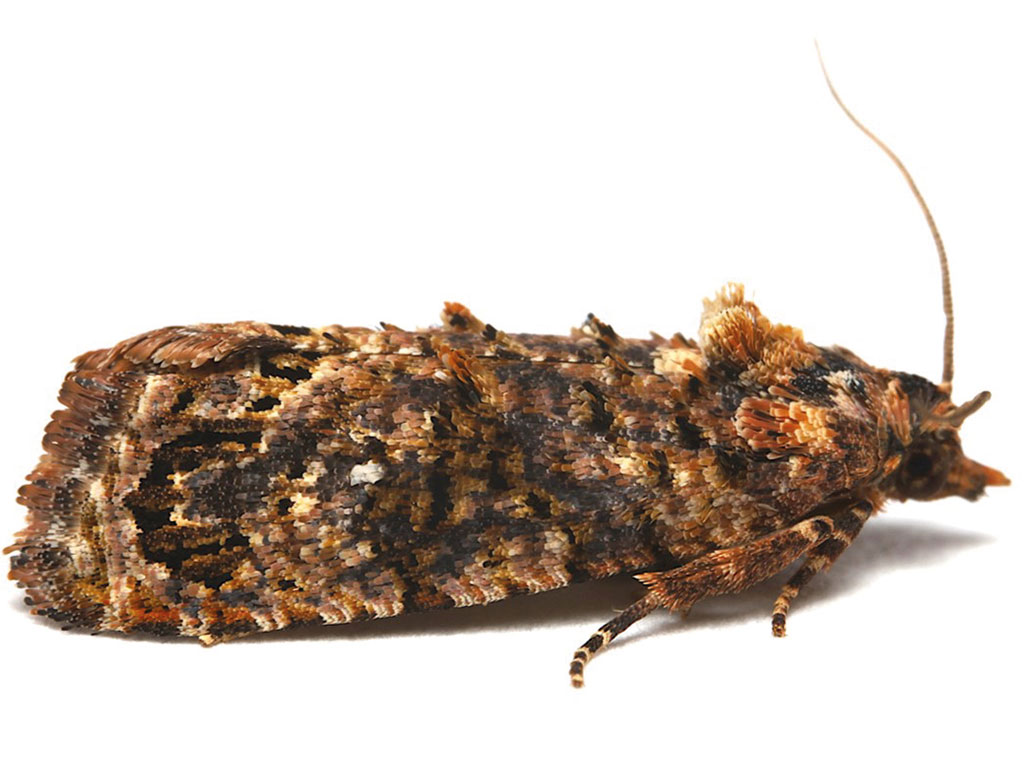


Adult Identification
- Wingspan: 16-22 mm (smaller than codling moth)
- Forewings: silver-grey with irregular dark-brown flecks and streaks
- Hindwings: pale grey, unmarked
- Orange-yellow abdomen tip visible when wings are spread
- At rest: holds wings flat over body in tent-like posture
- Nocturnal: most active from dusk to midnight
- Does not fly in cold or rainy conditions
Larval Identification
- Length at maturity: 15-17 mm
- Body: pink to cream-white, sometimes with a faint reddish tinge
- Head capsule: dark brown to black
- Distinct pinacula (dark spots) at base of each seta
- No obvious stripes or bands on the body
- Found boring through fruit toward the seed, surrounded by frass
- Exits fruit via a round exit hole 2-3 mm diameter
Taxonomy
| Kingdom | Animalia |
| Order | Lepidoptera |
| Family | Tortricidae |
| Genus | Thaumatotibia |
| Species | T. leucotreta |
Distribution
- Native to sub-Saharan Africa
- Present in all 47 Kenyan counties
- Established in Canary Islands (Spain)
- Interceptions in EU, USA, UK, Japan, Australia
- Expanding through global horticultural trade
- Altitude range: 0-2,400 m in Kenya
In Kenya, FCM is a primary constraint on avocado, citrus, macadamia, and rose exports. The EU, UK, and other importing markets classify FCM as a regulated quarantine pest: even a single larva or exit hole found in a shipment can result in rejection of the entire consignment, with the exporting farm placed on suspension. This gives FCM a commercial impact far beyond what visible field damage alone would suggest. A farm certified as a Low Prevalence Area for FCM commands a significant premium and market advantage.
FCM attacks over 30 plant species. It is primarily a pest of fleshy fruit crops, but also damages ornamentals, peppers, and cotton bolls. Kenya's most economically affected crops are listed below, with export market implications noted where applicable.
- Avocado (export crop, high risk)
- Citrus: orange, lemon, lime, mandarin
- Roses (cut flower, export)
- Macadamia (nut borer)
- Guava
- Pepper and capsicum
- Pomegranate
- Cotton (boll pest)
- Peach, plum, nectarine, apricot
- Mango
- Litchi and longan
- Fig and pawpaw
- Granadilla (passion fruit)
- Strawberry
- Grape
- Tomato (rare)
- Wild figs (Ficus spp.)
- Cape gooseberry (Physalis)
- Ornamental roses
- Hibiscus spp.
- Solanum spp.
- Various Prunus species
FCM completes its entire life cycle in 28-56 days depending on temperature, giving it 10-12 overlapping generations per year in Kenya's warm lowland regions and 6-8 at higher altitudes. Populations are continuous year-round, with no true dormant period. Understanding each stage is the foundation of effective management.
| Temperature | Generation Time | Larval Duration | Egg Hatch | Notes |
|---|---|---|---|---|
| 15 °C | ~70 days | 35-40 days | 10-12 days | Slow development; population growth limited |
| 20 °C | ~50 days | 22-28 days | 7-9 days | Typical highland Kenya (Nyandarua, Nyeri) |
| 25 °C | ~35 days | 16-20 days | 5-7 days | Optimal; most Kenyan avocado/citrus zones |
| 30 °C | ~28 days | 12-15 days | 4-5 days | Lowland coastal and semi-arid areas |
| 35 °C | ~22 days | 9-12 days | 3-4 days | Very fast; populations build rapidly in hot seasons |
FCM damage is caused entirely by feeding larvae, which bore into fruit and feed on the flesh and seed. The adult moth causes no direct damage. All damage is internal and largely invisible from outside the fruit until the larva exits or the fruit begins to drop and rot. This hidden nature is what makes FCM so commercially devastating: infested export fruit may appear perfect externally.


FCM damage is internally hidden in most crops. By the time larvae are visible or exit holes appear, the infestation is already advanced. Early detection depends on combining trap monitoring with active field scouting of specific early signs.
- Tiny 1-2 mm entry holes on fruit skin, often at the stem end or calyx region
- Red-brown wet frass extruding from entry holes (avocado and citrus)
- White silky frass at base of rose buds just below the calyx
- Premature fruit coloring (avocado turning purple or black early)
- Premature fruit drop: pick up and cut open dropped fruit
- Gum exudate around small entry wounds on citrus rind
- Distorted or non-opening rose buds on otherwise healthy stems
- Exit holes 3-4 mm diameter, larger than entry holes, on ripe or overripe fruit
- Pupae in light-coloured silken cocoons in topsoil under trees
- Moths resting motionless on rough bark or canopy undersides at daytime
This is the gold standard early warning system. Sex pheromone traps baited with FCM-specific synthetic lures attract and capture male moths before eggs are ever laid.
- Deploy Delta traps at 10 traps per hectare minimum for monitoring
- Hang traps at canopy height, in the lower outer third of the tree
- Check and count catches every 7 days; record on a scouting sheet
- Replace sticky inserts every 4-6 weeks or when 50% covered
- Replace lures every 6-8 weeks (check product label)
- Rising trap catches (upward trend over 3 consecutive weeks) signal an active egg-laying event
- In mass trapping programs: 30-50 traps per hectare
| Trap Catch (moths/trap/week) | Action Required |
|---|---|
| 0-2 | Low: continue monitoring, no immediate intervention |
| 3-7 | Moderate: intensify scouting, consider targeted control |
| 8-15 | High: immediate bioinsecticide spray; increase trap density |
| 15+ | Critical: full spray program + mating disruption + mass trapping |
| Crop | Market | Damage Threshold | Trap Threshold (moths/trap/week) |
|---|---|---|---|
| Avocado | EU Export (Hass, Fuerte) | ZERO Tolerance. One live larva or exit hole = consignment rejected | 3 moths signals immediate action; do not wait |
| Roses | Export (Netherlands, UK) | ZERO Tolerance. One infested bud per 200 inspected stems triggers rejection | 5 moths per trap per week; monitor weekly |
| Citrus | Local fresh market | 3-5% Infested fruit on random sample triggers control | 10 moths per trap per week |
| Citrus | Export | ZERO Tolerance for live larvae | 5 moths per trap per week |
| Pepper / Capsicum | Local market | 5-10% Infested fruit on random sample | 10 moths per trap per week |
| Macadamia | Export processed | ZERO Tolerance in kernel lots | 5 moths per trap per week |
- Collect and destroy all fallen fruit twice per week during the fruiting season (do not compost; bag and remove from the farm or bury at least 60 cm deep)
- Remove all mummified or shrivelled fruit remaining on the tree after harvest
- Strip-harvest remaining fruit on trees where infestation is confirmed rather than waiting for normal ripening
- Plough or disc the soil under trees after harvest to expose pupae to sun, desiccation, and bird predation
- In greenhouses with roses: remove all damaged and spent buds from the farm and destroy them off-site
- Avoid leaving overripe fruit in the field: this is the primary trigger for large egg-laying events
- Remove alternative host plants (wild figs, guava) from field margins where possible
- Sex pheromone traps using FCM-specific synthetic lure are the only tool that gives real-time population data
- Monitoring: 10 traps per hectare in Delta traps, hung at canopy height. Count catches weekly. Keep records for certification audits.
- Mass trapping: increase to 30-50 traps per hectare using Delta or funnel traps to actively remove males from the population
- Mass trapping alone does not eliminate FCM but significantly reduces the mating success rate, slowing population growth
- Combine mass trapping with mating disruption for maximum effect
- Mating disruption dispensers release a continuous plume of synthetic FCM female pheromone throughout the orchard or greenhouse
- The goal is not to kill moths but to prevent mating entirely: male moths are overwhelmed by the pervasive scent and cannot locate the real females
- Effective at 500-550 dispensers per hectare for orchards; 600-700 per hectare for greenhouses
- Best deployed at the beginning of fruiting, before populations build up (preventive tool, not a rescue measure)
- Provides 24-hour protection without contact with the crop, producing zero chemical residues
- Combine with mass trapping for certification as a Low Prevalence Area (LPA) for FCM, a requirement for premium EU export markets
- Entomopathogenic fungi (Beauveria bassiana, Metarhizium anisopliae): Apply at 1 kg/ha or 1 L/ha as a direct contact insecticide targeting newly hatched larvae on the fruit surface. Apply in the late afternoon or evening when UV intensity is low. Repeat every 7-10 days when trap catches are rising. Remains effective for 5-7 days post-application.
- Soil application of Metarhizium anisopliae: Drench or incorporate into the top 5 cm of soil under trees to infect and kill pupae in the soil. Apply at 2-4 kg/ha before the main flowering period to reduce the emerging adult population. Highly effective against the soil pupal stage.
- Apply bioinsecticides when: trap catches rise above threshold, immediately after sanitation runs, during and after rainfall events (which trigger adult emergence and egg-laying), and 10-14 days before harvest on export crops.
- Trichogramma egg parasitoid wasps: These tiny wasps lay their eggs inside FCM eggs on the fruit surface. The FCM egg is consumed before hatching. Release at 3 cards per hectare per week during peak trap activity. Works best in high-humidity conditions (greenhouses, dense orchards).
- Native parasitoids: Several Ichneumonid and Braconid wasps parasitise FCM larvae naturally. Conserve these by avoiding broad-spectrum chemical pesticides that kill natural enemies.
- Predatory insects: Earwigs, ground beetles, and spiders prey on larvae exiting fruit to pupate. Maintain ground cover and mulch to support ground predator populations.
- Harvest export avocados at the correct physiological maturity index: avoid leaving over-mature fruit on the tree, which attracts large egg-laying events
- Harvest at minimum 2-day intervals during peak FCM pressure, especially for roses
- Post-harvest cold-chain storage at below 6 °C kills any larvae present in fruit within 10-16 days (an EU-approved disinfestation measure)
- In greenhouses: seal entry points and use 50-mesh insect screens on vents to prevent adult moth entry
- Tree nutrition: well-fed trees produce thicker skins that are harder for young larvae to penetrate; ensure adequate calcium and potassium nutrition
- Apply foliar chitosan to thicken and toughen the fruit skin, making penetration by young larvae harder and also triggering the tree's own immune response
These products from Bioenemy Africa are suitable for FCM management at different stages of the pest life cycle. They are integrated as part of a complete IPM program, not as standalone rescue treatments.
Use FCM-Enemy lures in Delta traps for monitoring and early warning. Scale up to Funnel traps for mass trapping. Use FCM-ENEMY MD dispensers for orchard-wide mating disruption.
Apply to fruit surface when trap catches are rising to contact newly hatched larvae before they bore in. Apply Metarhizium as a soil drench to kill pupae in the soil.
Release at 3 cards per hectare weekly during peak moth activity. Most effective in enclosed or sheltered growing environments.
Apply as a foliar spray to fruit and leaves during fruit development. Chitosan thickens the fruit epidermis making it harder for young larvae to penetrate, and also triggers systemic resistance (SAR) in the plant.
| Pest Stage | Tool / Approach | Timing | Notes |
|---|---|---|---|
| Adult (male moth) | Pheromone monitoring traps | Year-round, from pre-flowering | 10 traps/ha minimum; check weekly |
| Adult (mating) | Mating disruption dispensers | From 6-8 weeks before harvest window | 500-550 units/ha; no residue |
| Eggs (on fruit surface) | Trichogramma egg parasitoid cards | Weekly during peak trap activity | 3 cards/ha/week; best in greenhouses |
| Young larvae (0-48 hrs) | Beauveria bassiana + Metarhizium spray | When catches rise; every 7-10 days | Apply late afternoon; repeat on schedule |
| Pupae (in soil) | Metarhizium soil drench | Pre-flowering + 3 weeks after | 2-4 kg/ha; target top 5 cm soil |
| All stages (continuous) | Sanitation (fallen fruit removal) | Twice per week during fruiting | Most cost-effective single action |
| All stages (continuous) | Chitosan foliar spray | Every 14 days from fruit set | Hardens fruit skin; activates SAR |